
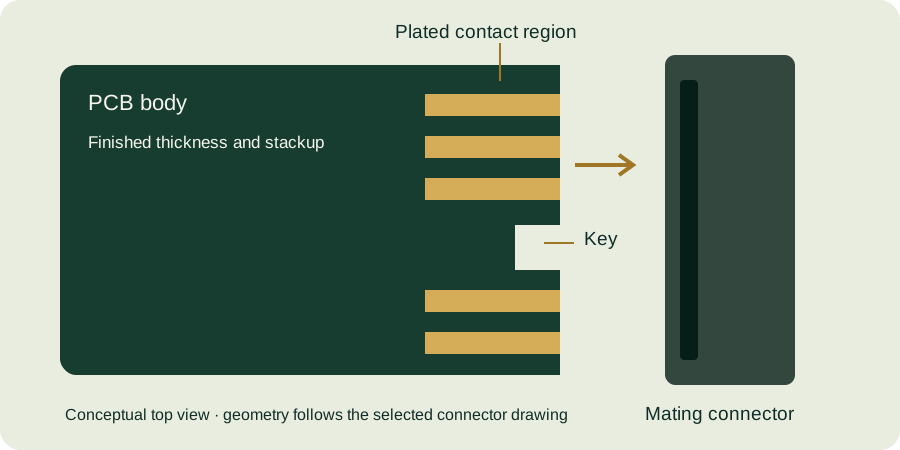
Give the prototype a specific job
A prototype is most useful when it answers a question that would otherwise reach production unresolved. For gold fingers, common questions concern connector fit, contact wipe location, finish compatibility, insertion force, signal behavior and clearance after assembly. Write those questions before choosing the quantity or delivery priority.
Keep prototype and production requirements connected
If the prototype is intended to qualify a production interface, specify the intended finish and critical dimensions. A cheaper or faster substitute may still be useful for a limited test, but record what it cannot demonstrate. Mechanical fit, solder assembly and long-term contact wear may require different evidence.
| Prototype objective | What to hold constant |
|---|---|
| Mechanical fit | Connector revision, final thickness, outline, keying and bevel. |
| Electrical channel | Relevant stackup, routing, vias and connector configuration. |
| Contact evaluation | Finish system, contact geometry and mating counterpart. |
| Assembly clearance | Component envelopes, fixture access and enclosure geometry. |
| Production transfer | Approved files, tolerances, material requirements and acceptance plan. |
Close the loop after the first build
Record the build revision and the parts used in testing. Distinguish a design correction from a process adjustment, and reflect accepted changes in the fabrication drawing. If the connector, material or plating specification changes, decide which previous tests are still applicable rather than assuming the qualification carries forward.
Make quotation options comparable
Submit separate quantities and identify which specifications are fixed. Ask for any proposed alternative to be stated explicitly. Compare the same finish thickness basis, board construction, testing and documentation across options; a lower price is not meaningful when the underlying requirements differ.
A practical release checklist
Use the interactive readiness checklist as a starting point. Confirm drawing revision, layer stack, finish map, mechanical datum, connector details, quantities and inspection requirements. The checklist is an aid to discussion, not an automated engineering approval.
Have a drawing to review? Send your gold finger PCB requirements with the connector part number, quantities and any open questions. Files are optional.