
Use explicit units and an acceptance basis
Gold thickness is commonly discussed in microinches and micrometers. One microinch is exactly 0.0254 micrometers. A unit conversion is exact arithmetic; choosing the correct thickness for a contact system is an engineering decision. Always state whether a drawing value is a minimum, nominal value or another agreed acceptance limit.
| Illustrative thickness (µin) | Equivalent thickness (µm) |
|---|---|
| 10 | 0.254 |
| 15 | 0.381 |
| 30 | 0.762 |
| 50 | 1.270 |
| 100 | 2.540 |
These values illustrate conversion only. They are not a recommended thickness range, a list of available services or a guarantee of mating life.
Why “30 microinches” is an incomplete callout
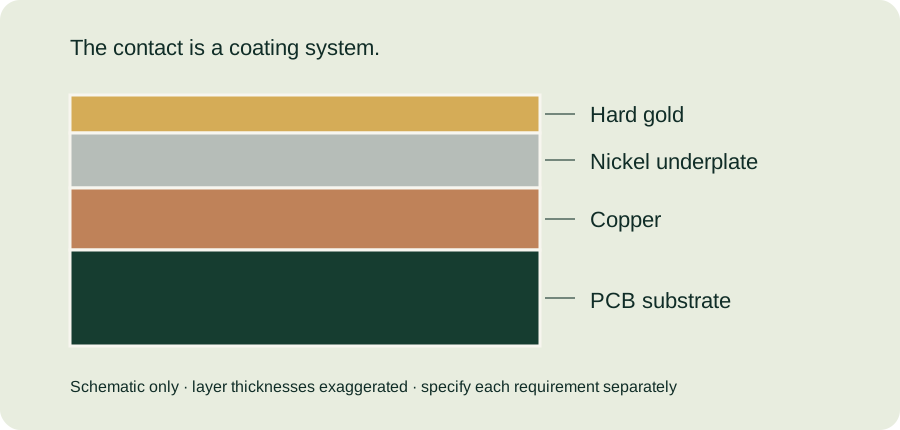
The statement leaves several questions unanswered: which deposit, over which underplate, measured where, on which contacts and accepted by what method? A supplier may otherwise interpret the number differently from the designer. Include the selective plating area, minimum local requirement, measurement locations and agreed sampling in the drawing or purchase specification.
Choose thickness using the complete contact system
Consider the mating finish, contact force and wipe, expected service cycles, environment and qualification evidence. More gold cannot correct a poor mechanical fit or an unsuitable connector design. Similarly, a low-cycle application does not automatically justify the thinnest available coating when contamination or reliability requirements dominate.
Understand measurement without overreading it
A coating measurement establishes a property at the measured location under the method’s assumptions. Ask for suitable calibration, layer-system settings and a defined measurement plan. A single measurement or a panel average does not automatically demonstrate every contact meets a minimum local requirement. Agree the relevant evidence before the order is released.
See how thickness affects ideal material usage
The engineering toolkit converts thickness and estimates theoretical gold mass from plated area. Doubling thickness doubles ideal material volume at constant area; it does not necessarily double the complete PCB price. Processing and other fabrication costs remain separate.
Connector manufacturer perspective
Samtec’s discussion of gold thickness emphasizes that plating thickness alone cannot establish the performance of a connector system. Apply the actual selected connector’s documentation rather than transferring cycle counts between unrelated designs.
Have a drawing to review? Send your gold finger PCB requirements with the connector part number, quantities and any open questions. Files are optional.